Historical landmark
Trinity Green Almshouses
About this place
Discover Trinity Green Almshouses
Situated in the heart of London's East End, the Trinity Green Almshouses stand as a testament to the city's rich maritime heritage and architectural history. Constructed in 1695 by the Corporation of Trinity House, these almshouses were designed to provide housing for 28 retired sailors and the widows of seafarers. The land for this project was generously donated by Captain Henry Mudd of Ratcliffe, an Elder Brother of Trinity House, whose contributions were instrumental in the establishment of this charitable institution. (londonremembers.com)
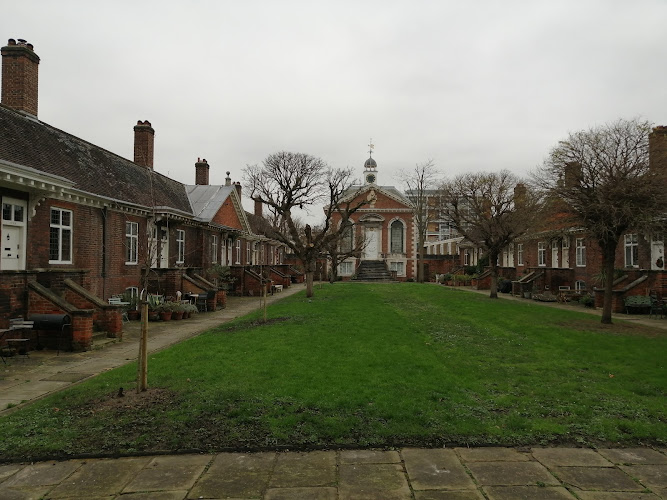
Architecturally, the complex is a remarkable example of late 17th-century design. The almshouses are arranged in two rows facing a central courtyard, with a detached chapel at the northern end. Each red-brick cottage features a single storey and basement, adorned with wood block and bracketed eaves cornices. The entrances are distinguished by wide hoods supported by carved brackets, adding to the building's period charm. The chapel, located at the north end of the complex, is accessed via a flight of stone steps and is surmounted by a clock turret, enhancing the site's architectural diversity. (historicengland.org.uk)
Over the centuries, the Trinity Green Almshouses have faced several challenges. In 1895, proposals for their demolition were met with strong opposition from notable figures such as Charles Robert Ashbee, William Morris, and Octavia Hill. Their advocacy led to the preservation of the almshouses, marking them as the first historic building in the East End to be saved for posterity. ({{LINK0}}) During World War II, the complex suffered bomb damage, resulting in the destruction of the northern range of almshouses and the chapel. In the 1950s, the remaining structures were restored by the London County Council, with the chapel being refurbished using 18th-century panelling from Bradmore House in Hammersmith. ({{LINK1}})
In recent years, the Trinity Green Almshouses have continued to face development pressures. In 2016, a proposal for a 28-storey tower block near the site was met with strong opposition from local residents and preservationists, who argued that the new development would overshadow the historic almshouses. The campaign was successful, and the proposal was abandoned, ensuring the continued prominence of the almshouses in the local landscape. (spitalfieldslife.com)
Today, the Trinity Green Almshouses remain a cherished landmark, reflecting London's commitment to preserving its historical and architectural heritage amidst the challenges of urban development.
Location