Historical landmark
Gladstone statue
About this place
Discover Gladstone statue
Statue of William Ewart Gladstone
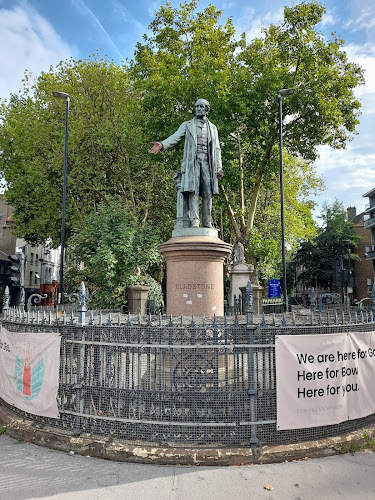
The bronze statue of William Ewart Gladstone, located at the western end of St Mary's Churchyard on Bow Road in London, stands as a testament to the former Prime Minister's influence and the area's rich history. Unveiled in 1882, the statue was commissioned by Theodore H. Bryant, co-owner of the nearby Bryant and May match factory, and sculpted by Albert Bruce-Joy. (bowheritagetrail.org)
William Ewart Gladstone (1809–1898) was a prominent British politician who served as Prime Minister four times between 1868 and 1894. A member of the Liberal Party, he was known for his advocacy of free trade, electoral reform, and Irish home rule. His tenure was marked by significant political and social reforms, earning him the nickname "The People's William." (bowheritagetrail.org)
The statue depicts Gladstone in a dynamic pose, with one hand extended as if delivering a grand principle, capturing his oratorical prowess. The likeness was widely praised upon its unveiling, with contemporary reports highlighting its striking resemblance to the Prime Minister. (london-walking-tours.co.uk)
An intriguing aspect of the statue is the red coloration of Gladstone's hands. This feature has been the subject of various interpretations and urban legends. One prevalent story suggests that the matchgirls employed at Bryant and May's factory had a shilling deducted from their wages to fund the statue, leading to protests during its unveiling. However, this narrative lacks substantial historical evidence and is considered more of a local myth. (london-walking-tours.co.uk)
In reality, the red hands are believed to be a modern addition, painted in 1988 to commemorate the centenary of the matchgirls' strike, which was a significant labor movement advocating for better working conditions. The strike highlighted the exploitation and hazardous conditions faced by workers, including issues like white phosphorus poisoning. The red hands serve as a symbolic gesture of solidarity with the matchgirls and a reminder of the labor struggles of the past. (london-walking-tours.co.uk)
Adjacent to the statue is a Grade II listed gentlemen's public convenience, constructed in 1899 by the Poplar Board of Works. Designed by George Jennings, a pioneer in public sanitation, the facility features decorative iron railings and cast-iron gates, with the initials "WEG" (William Ewart Gladstone) prominently displayed. The interior boasts russet marble urinals and terrazzo flooring, reflecting the period's attention to detail in public amenities. (historicengland.org.uk)
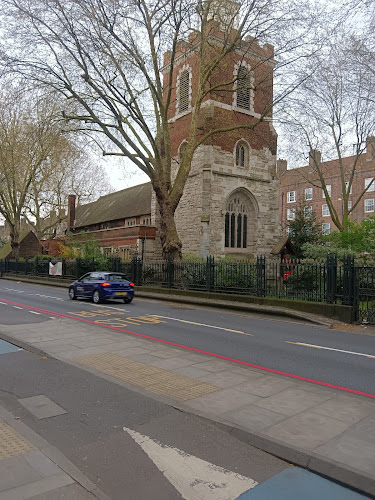
The statue, along with the church and surrounding structures, forms a focal point in the center of Bow Road, contributing to the area's historical and architectural significance. It stands as a testament to Gladstone's legacy and the rich tapestry of London's East End history.
Location