Tourist attraction
The King's Gallery, Buckingham Palace
About this place
Discover The King's Gallery, Buckingham Palace
The King's Gallery
The King's Gallery, situated within the historic confines of Buckingham Palace, stands as a testament to the British monarchy's enduring patronage of the arts. This esteemed public art gallery offers visitors an intimate glimpse into the Royal Collection, one of the most significant and extensive art collections globally. The gallery's rich history, architectural evolution, and cultural significance provide a fascinating narrative that intertwines with the broader tapestry of British heritage.
Historical Background
The origins of the King's Gallery trace back to the early 19th century during the reign of King George III. In 1761, King George III acquired Buckingham House, a private townhouse, for Queen Charlotte, his consort, as a retreat from the formalities of St James’s Palace. This acquisition marked the beginning of Buckingham House's transformation into the grand Buckingham Palace. As part of this transformation, architect John Nash was commissioned to redesign and expand the palace, incorporating new wings and pavilions that would enhance its grandeur and functionality.
Among the architectural additions was a conservatory designed in the form of an Ionic temple, completed in 1831. This conservatory, located on the southwest corner of the palace facing the garden, was intended to serve as a private chapel for Queen Victoria. In 1843, the conservatory was converted into a private chapel, reflecting the evolving needs and preferences of the royal family. However, during the Second World War, the chapel was destroyed in an air raid in 1940, leaving behind a site that would later be repurposed for a new purpose.
In 1962, at the suggestion of Queen Elizabeth II and Prince Philip, The Duke of Edinburgh, the ruins of the chapel were redeveloped into a gallery to showcase works from the Royal Collection. This initiative aimed to make the royal art collection more accessible to the public and to preserve the legacy of the destroyed chapel. The gallery, initially known as the Queen's Gallery, opened its doors to the public, marking a significant moment in the history of Buckingham Palace and the Royal Collection. (rct.uk)
Architectural Evolution
The original design of the Queen's Gallery was conceived by architect Sir Hugh Casson, who aimed to create a space that would harmoniously blend with the existing architecture of Buckingham Palace while providing a suitable environment for displaying artworks. The gallery comprised three main exhibition rooms and several smaller spaces, offering a modest yet elegant setting for the Royal Collection.
In 1997, a competition was held to appoint an architect to expand and modernize the gallery in celebration of Queen Elizabeth II's Golden Jubilee. John Simpson & Partners were selected for this significant project, which marked the most substantial addition to Buckingham Palace in 150 years. The expansion aimed to enhance the gallery's capacity, improve visitor access, and incorporate state-of-the-art environmental controls to preserve the artworks.
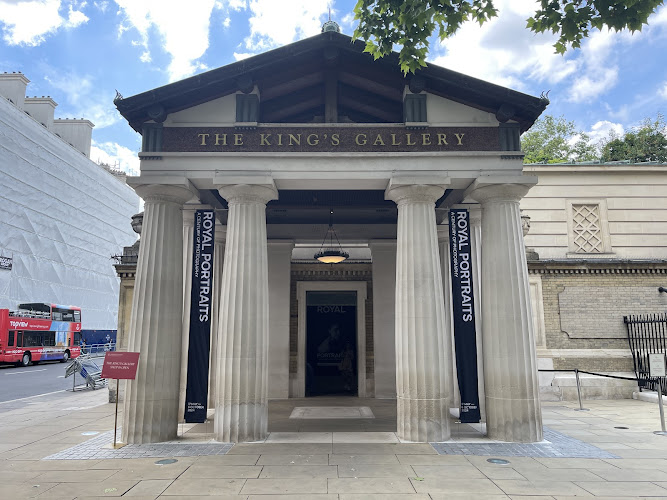
The redesigned gallery, reopened in May 2002, featured a new Doric entrance portico, providing a grand and welcoming facade. The interior spaces were reconfigured to allow for more flexible exhibition arrangements, accommodating a diverse range of artworks and temporary exhibitions. The expansion also included the creation of additional rooms, more than tripling the gallery's original space, thereby enriching the visitor experience and allowing for a more comprehensive display of the Royal Collection. (rct.uk)
The Royal Collection
The Royal Collection, housed within the King's Gallery, is one of the largest and most important art collections in the world. It encompasses a vast array of artworks, including paintings, drawings, sculptures, decorative arts, and manuscripts, amassed by British monarchs over centuries. The collection reflects the tastes, interests, and patronage of successive monarchs and serves as a testament to the rich cultural heritage of the United Kingdom.
Notable artists featured in the gallery's exhibitions include Leonardo da Vinci, Rembrandt, Vermeer, and Canaletto. These masterpieces offer visitors a unique opportunity to engage with some of the most celebrated works in art history
Location