Garden
Quaker Gardens
London EC1Y 8PW, United Kingdom
Audio guide Listen to the audio guide for Quaker Gardens Tap to listen in Voicemarks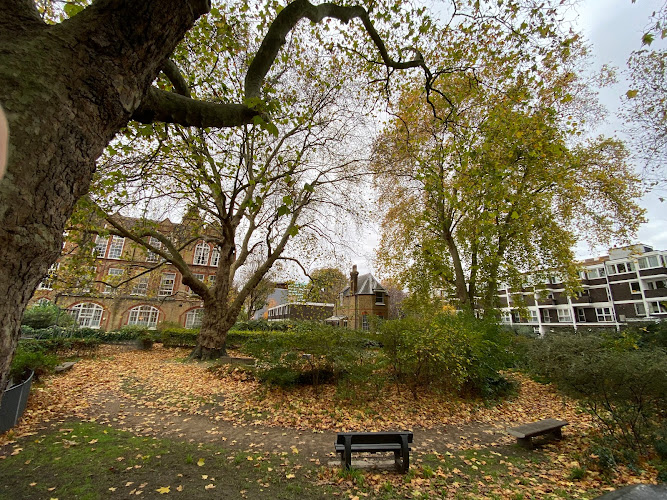
Quaker Gardens, located in the London Borough of Islington, is a historic public park that serves as a testament to the city's rich Quaker heritage. Established in 1661, it was originally a burial ground for members of the Religious Society of Friends, commonly known as Quakers. Over the years, the site has undergone several transformations, evolving from a sacred resting place to a vibrant community space.
Historical Significance
The Quakers acquired the land in 1661, marking it as their first freehold property in London. Over the next two centuries, thousands of Quakers were interred here, including prominent figures such as George Fox, the founder of the Quaker movement, who passed away in 1691. The burial ground was officially closed in 1855. (bunhillquakers.org.uk)
Memorial Buildings
In 1881, the Quakers constructed the Memorial Buildings on the site, which included a large meeting house, committee rooms, an adult school, a reading room, a medical mission, lodging rooms, and a teetotal "Coffee-Tavern Club." However, during World War II, the buildings suffered significant bomb damage, leading to the demolition of all but one wing. The surviving structure, originally the caretaker's house, was redeveloped in 1976 and now functions as a Quaker meeting house. (en.wikipedia.org)
Transformation into a Public Garden
After the closure of the burial ground, the land underwent various changes. In 1965, it was transformed into a public recreation ground within the Greater London Council's Banner Street estate. The park features mature plane trees, a children's playground, and a tarmac ball court with basketball hoops. A section of the garden is dedicated to the Quakers' Horticultural Project, which runs horticultural therapy workshops. (parksandgardens.org)
Notable Burials
The site is the final resting place for several notable Quakers, including:
- Ann Austin (d. 1665): A traveling Quaker preacher.
- John Bellers (1654–1725): A political and educational theorist and writer.
- Joseph Gurney Bevan (1753–1814): A writer of Quaker apologetical works.
- Edward Burrough (1634–1663): A Quaker leader and controversialist.
- Joan Dant (1631–1715): A notable Quaker figure.
- George Whitehead (1636–1723): A Quaker leader and author of memoirs.
These individuals played significant roles in the development and spread of Quakerism. (en.wikipedia.org)
Visiting Quaker Gardens
Today, Quaker Gardens offers a peaceful retreat amidst the urban landscape of London. The park is open daily from 8:00 am to dusk, providing a space for relaxation, reflection, and community activities. Its rich history and serene environment make it a noteworthy destination for those interested in London's Quaker heritage and urban green spaces. (parksandgardens.org)
Conclusion
Quaker Gardens stands as a testament to the enduring legacy of the Quaker community in London. From its origins as a burial ground to its current role as a public park, it continues to serve as a place of reflection, community engagement, and historical significance.
Location
Place details
- Area
- London, London
- Country
- United Kingdom
- Map
- Open in maps