Anglican church
St James Garlickhythe
About this place
Discover St James Garlickhythe
St James Garlickhythe
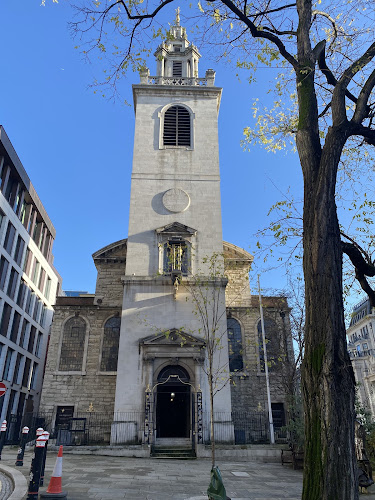
St James Garlickhythe, often referred to as "Wren's Lantern" due to its abundant natural light, is a Church of England parish church located in the Vintry ward of the City of London. The church's dedication to St. James the Great reflects its historical significance, as it has been a place of worship since the 12th century. (en.wikipedia.org)
The church's name, "Garlickhythe," derives from the nearby landing place where garlic was sold in medieval times. The earliest surviving reference to the church is as "ecclesiam Sancti Jacobi" in a 12th-century will. Over the centuries, it has been known by various names, including St James in the Vintry, St James Comyns, St James-by-the-Thames, and St James super Ripam. (en.wikipedia.org)
In the 14th century, the church was rebuilt by Richard de Rothing and his son John, both prominent Vintners. This period marked the church's deepening association with the wine trade, a connection that continues today, as it serves as the official church for several City livery companies, including the Vintners. (en.wikipedia.org)
The original structure was destroyed in the Great Fire of London in 1666. Reconstruction began in 1676 under the guidance of Sir Christopher Wren, with the church reopening in 1682. The tower, designed by Nicholas Hawksmoor, was completed in 1717. The church's design is notable for its profusion of windows, earning it the nickname "Wren's Lantern." (en.wikipedia.org)
The church's interior features a 40-foot high ceiling, the highest of any Wren church, and a nave with two narrow aisles. The chancel, flanked by pilasters, is slightly narrower than the nave. The original woodwork includes the altar table carved with doves, the font cover, and the churchwardens' pews at the west end. The font, made of marble with carved cherub heads, was crafted by Wren's master stone mason, Christopher Kempster. (en.wikipedia.org)
The church's tower is adorned with a clock featuring an image of St. James, a 1988 replica of a 1682 original. The spire, designed by Nicholas Hawksmoor, is similar to those of St Stephen Walbrook and St Michael Paternoster Royal. The gates to the west, featuring vine leaf and grape motifs, were a gift from the Vintners' Company. (en.wikipedia.org)
St James Garlickhythe has a rich history of associations with notable figures. In 1711, Richard Steele attended a Sunday service at the church, publishing his reflections in The Spectator. A month later, the future composer and Master of the King's Music, William Boyce, was baptized here. In 1860, Charles Dickens attended a Sunday service at St. James Garlickhythe, describing the congregation as dwindled to twenty, with the building pervaded with damp and dust. (en.wikipedia.org)
During World War II, the church suffered damage from a bomb dropped by a Zeppelin in 1917 and a 500lb German high explosive bomb in 1941. The latter bomb crashed through the roof but did not explode. The church was closed until 1963 for restoration, which was praised by Sir John Betjeman as the best restoration of a City church. (en.wikipedia.org)
Today, St James Garlickhythe continues to serve as a place of worship and community in the heart of the City of London. The church is open for visitors Monday to Friday from 10:30 am to 4 pm, in addition to regular Sunday services. (nationalchurchestrust.org)
The church's dedication to St. James the Great reflects its historical significance, as it has been a place of worship since the 12th century. (en.wikipedia.org)
The church's dedication to St. James the Great reflects its historical significance, as it has been a place of worship since the 12th century. (en.wikipedia.org)
The church's dedication to St. James the Great reflects its historical significance, as it has been a place of worship since the 12th century. (en.wikipedia.org)
The church's dedication to St. James the Great reflects its historical significance, as it has been a place of worship since the 12th century. (en.wikipedia.org)
The church's dedication to St. James the Great reflects its historical significance, as it has been a place of worship since the 12th century. (en.wikipedia.org)
The church's dedication to St. James the Great reflects its historical significance, as it has been a place of worship since the 12th century. (en.wikipedia.org)
The church's dedication to St. James the Great reflects its historical significance, as it has been a place of worship since the 12th century. (en.wikipedia.org)
The church's dedication to St. James the Great reflects its historical significance, as it has been a place of worship since the 12th century. (en.wikipedia.org)
The church's dedication to St. James the Great reflects its historical significance, as it has been a place of worship since the
Location