Church
The Assumption of the Blessed Virgin Mary Church
About this place
Discover The Assumption of the Blessed Virgin Mary Church
Assumption of the Blessed Virgin Mary Church
The Assumption of the Blessed Virgin Mary Church in Beckley, Oxfordshire, is a Grade I listed building renowned for its historical and architectural significance. Dating back to the 14th and 15th centuries, the church showcases remarkable medieval craftsmanship and artistry.
Historical Background
The church's origins trace back to a Norman structure, with significant rebuilding occurring in the 14th and 15th centuries. This period of reconstruction introduced the current nave, chancel, north and south aisles, and the central embattled tower. Notably, the church retains much of its original stonework, including the tracery in the windows, offering a rare glimpse into medieval ecclesiastical architecture. (oxfordshirevillages.co.uk)
Architectural Features
Architecturally, the church is characterized by its limestone rubble construction with ashlar dressings and a combination of plain-tile and sheet-metal roofs. The 14th-century chancel features two-light side windows and a three-light east window, all with reticulated tracery. The steep-pitched roof has a gable parapet, adding to the building's grandeur. The central tower, crenellated and three-staged, is flanked by the aisles and showcases the roofline of former transepts. A notable feature is the two-stage circular stair turret at the north-east angle, topped with a short octagonal spirelet, which may date back to the 13th century or earlier. (britishlistedbuildings.co.uk)
Interior Art and Artifacts
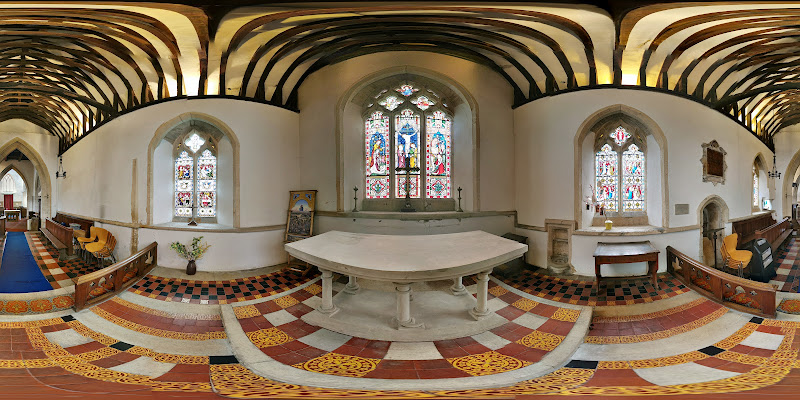
Inside, the church boasts an array of 14th- and 15th-century wall paintings, including depictions of the Virgin and Child, the Annunciation, the weighing of souls, and the torments of the damned. These artworks provide valuable insights into medieval religious iconography and the artistic styles of the period. The church also houses a 12th-century tub font, 15th-century bench pews, a 17th-century pulpit with arched panels and tester, and a medieval chest, all contributing to its historical ambiance. (britishlistedbuildings.co.uk)
Bell Tower
The bell tower has evolved over the centuries. By 1552, it housed four large bells and a Sanctus bell. While the Sanctus bell has been lost, the tower now features a ring of five bells. Richard Keene of Woodstock cast the treble bell in 1650 and the third bell in 1654. Richard III Chandler of Drayton Parslow, Buckinghamshire, cast the fourth bell in 1705, and Henry III Bagley of Chacombe, Northamptonshire, cast the second bell in 1707. The present tenor bell was cast by Mears and Stainbank of the Whitechapel Bell Foundry in 1881. For technical reasons, the bells are currently unringable. (ohct.org.uk)
Community and Services
The church remains an active place of worship and community gathering. Services are held on the first, second, and fifth Sundays of each month at 9:30 a.m., with a variety of services including Common Worship Communion, Morning Prayer, and Book of Common Prayer Communion. On the third Sunday, an Iona service is held at 6 p.m., offering a short service of Celtic-style worship accompanied by hymns and instrumental music. The church is open every day, usually from 9:30 a.m. until 6 p.m., providing a space for private prayer and reflection. ({{LINK0}}, {{LINK1}})
Conservation and Preservation
As a Grade I listed building, the church is recognized for its exceptional architectural and historical importance. Efforts to preserve its structure and artworks are ongoing, ensuring that future generations can appreciate its rich heritage. The church is situated within a conservation area, reflecting the community's commitment to maintaining the village's historical character. (achurchnearyou.com)
Visitors to the church are encouraged to explore its rich history, admire its architectural beauty, and participate in its vibrant community life.
Location