Bridge
Sydney Harbour Bridge
About this place
Discover Sydney Harbour Bridge
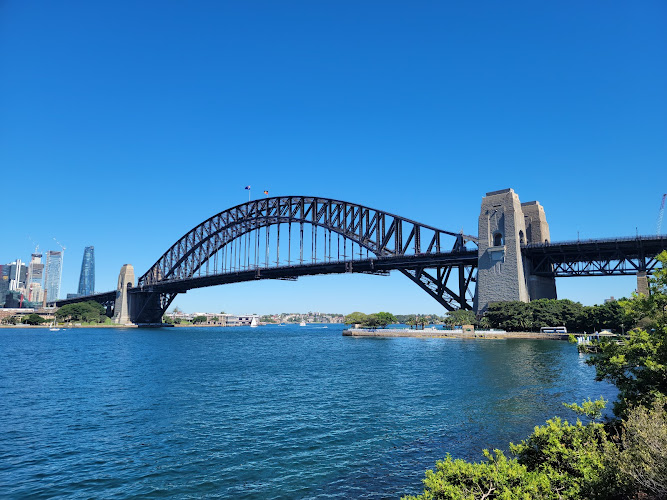
The Sydney Harbour Bridge, affectionately known as "The Coathanger" due to its distinctive arch design, stands as a testament to Australia's engineering prowess and serves as an iconic symbol of Sydney. Completed in 1932, this monumental structure spans 503 meters across Sydney Harbour, connecting the central business district to the North Shore. Its design and construction reflect a blend of technical innovation and cultural significance, making it a focal point of Sydney's urban landscape. (britannica.com)
Historical Background
The concept of a bridge spanning Sydney Harbour dates back to the early 19th century. In 1815, Francis Greenway, a convict-turned-architect, proposed a bridge to Governor Macquarie, envisioning it as a means to unite the northern and southern parts of the colony. However, it wasn't until 1912 that the idea gained serious momentum. Engineer J.J.C. Bradfield presented plans for a bridge that would serve as a key element of an integrated transport system, including an extensive network of rail and roadways leading to the bridge. His vision was to create a structure that would not only facilitate transportation but also symbolize Australia's progress and modernity. (dcceew.gov.au)
The design process was meticulous. Bradfield's proposal was for a cantilever bridge, but advancements in steelmaking technology and the economic climate of the time led to the adoption of a steel arch design. This design was not only more cost-effective but also capable of handling heavier loads, aligning with the growing transportation needs of Sydney. The contract for construction was awarded to Dorman Long & Co., a British firm renowned for its expertise in steel structures. Sir Ralph Freeman, the chief engineer, played a pivotal role in finalizing the design and overseeing the construction process. (britannica.com)
Construction and Engineering Feats
Construction of the Sydney Harbour Bridge commenced in 1924 and was completed in 1932, spanning eight years. The project employed over 2,000 workers and utilized 53,000 tonnes of steel and six million hand-driven rivets. The deep waters of Sydney Harbour posed significant challenges, making temporary supports impractical. To address this, the steel arch was assembled by building out from each bank, with the two sides meeting in the middle on 19 August 1930. This engineering feat was a testament to the ingenuity and determination of the workers and engineers involved. (britannica.com)
Architectural Design and Features
The Sydney Harbour Bridge is a steel through-arch bridge, with a main span of 503 meters and a total length of 1,149 meters. The arch rises 134 meters above the water, making it the tallest steel arch bridge in the world. Its design closely resembles the Hell Gate Bridge in New York City, reflecting the influence of American engineering on Australian infrastructure. The bridge's width of 48.8 meters accommodates eight lanes of vehicular traffic, two sets of train tracks, a bicycle path, and a pedestrian walkway, showcasing its versatility and capacity. (asce.org)
Cultural Significance
Beyond its functional role, the Sydney Harbour Bridge holds profound cultural significance. It has been a focal point for major events, including the annual New Year's Eve fireworks, drawing millions of viewers worldwide. The bridge also symbolizes Australian progress and ingenuity, reflecting the nation's engineering achievements. Its completion during the Great Depression was seen as a beacon of hope and resilience, embodying the spirit of the Australian people. (nma.gov.au)
Notable Events and Milestones
The opening of the Sydney Harbour Bridge on 19 March 1932 was a momentous occasion, drawing crowds of nearly one million people. The ceremony was marked by a touch of controversy when Francis de Groot, a member of the New Guard right-wing paramilitary group, rode his horse through the crowd and cut the ribbon first. This act was a protest against the New South Wales Premier Jack Lang's policies and the absence of King George V at the opening. (nma.gov.au)
In 2000, the bridge became a symbol of reconciliation when an estimated 250,000 people participated in the People's Walk for Reconciliation, crossing the bridge to support the process of Aboriginal reconciliation. This event highlighted the bridge's role as a unifying
Location