tourist attraction
Westminster Abbey
About this place
Discover Westminster Abbey
Westminster Abbey
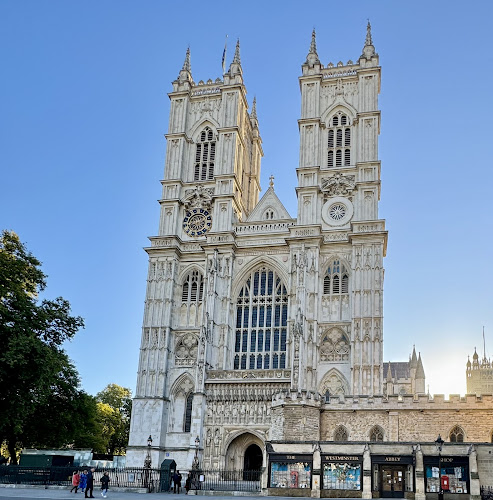
Westminster Abbey, situated in the heart of London, stands as a testament to over a millennium of British history, culture, and architectural evolution. Its significance transcends its role as a place of worship, embodying the nation's heritage and serving as a focal point for national ceremonies and commemorations.
Origins and Early History
The origins of Westminster Abbey trace back to the early 10th century. In approximately 960 AD, Benedictine monks established a house of worship on Thorney Island, a small area in the River Thames. This site, known as 'West Minster' to distinguish it from the 'East Minster' in Canterbury, became a center of Christian worship and monastic life. (history.com)
The Abbey's association with the English monarchy began with King Edward the Confessor, who, in the mid-11th century, commissioned the construction of a new church on the site. This church, consecrated in 1065, was designed in the Romanesque style and served as a royal mausoleum. Edward the Confessor himself was buried there, and his shrine became a focal point for pilgrims. (britannica.com)
Gothic Transformation
The most significant transformation of Westminster Abbey occurred in the 13th century during the reign of King Henry III. In 1245, Henry III embarked on an ambitious project to rebuild the Abbey in the Gothic style, reflecting the architectural trends of the time and his devotion to Edward the Confessor. This rebuilding introduced features such as pointed arches, ribbed vaulting, and flying buttresses, which are characteristic of Gothic architecture. The design was influenced by contemporary French cathedrals, incorporating elements like an apse with radiating chapels. (westminster-abbey.org)
The construction was overseen by master masons Henry of Reyns, John of Gloucester, and Robert of Beverley. The project was ambitious, aiming to create a structure that was both a place of worship and a monumental statement of royal power. The Abbey's design incorporated an east-west axis, determined by the existing position of the Lady Chapel, and featured a high nave with wide projecting transepts, distinguishing it from continental Gothic cathedrals. (westminster-abbey.org)
Coronations and Royal Ceremonies
Since 1066, Westminster Abbey has been the site of every English and later British coronation, serving as the coronation church for forty monarchs. The tradition began with William the Conqueror, who was crowned there in 1066. The Abbey's role in these ceremonies underscores its significance as a symbol of continuity and national identity. (westminster-abbey.org)
In addition to coronations, the Abbey has hosted numerous royal weddings and funerals, further cementing its status as a central figure in the nation's ceremonial life. These events are not only significant for the royal family but also for the nation, as they are occasions for public celebration and reflection.
Burials and Memorials
Westminster Abbey serves as the final resting place for 17 monarchs, including Elizabeth I, Mary I, and Mary, Queen of Scots. The Abbey's Poets' Corner is particularly famous, commemorating figures such as Geoffrey Chaucer, William Shakespeare, and Jane Austen. (westminster-abbey.org)
The Abbey's role as a burial site extends beyond royalty and poets. Over 3,300 notable individuals are interred or commemorated within its walls, including scientists like Sir Isaac Newton, politicians like Sir Winston Churchill, and military leaders like Lord Nelson. This diverse array of individuals reflects the Abbey's role as a repository of the nation's history and achievements.
Architectural Features
The Abbey's architecture is a testament to the skill and vision of its builders. The high nave, with its nearly 102-foot-high Gothic vault, creates a sense of verticality and lightness. The use of Purbeck marble for the columns adds a distinctive touch to the interior. The Lady Chapel, built by Henry VII, is renowned for its exquisite fan vaulting, a masterpiece of Perpendicular Gothic design. (westminster-abbey.org)
The Abbey's design also reflects a blend
Location